
Curtain Tolerances in Australia - How Much Do Curtains Shrink or Move?
Not all curtains are created equal - and not all suppliers have the experience to get them right.
It's one of the most important things to understand when investing in custom curtains in Perth or anywhere in Australia.
Two suppliers can specify the same fabric for the same window and produce two completely different curtains. Sometimes the gap is obvious the day they're hung. Sometimes it shows up weeks or months later, as the seasons change and the fabric responds. Same fabric. Different expertise.
At Sun Solutions, we've been supplying custom curtains in Perth and across Western Australia for more than 20 years. That's the experience and expertise it takes to get them right - particularly when it comes to one of the most misunderstood aspects of custom curtains: how much they can move, and why.
How Much Do Curtains Shrink or Move?
In Australia, the industry-accepted upper limit for curtain fabric movement is approximately 3% of curtain length.
In real terms:
A 2.5m curtain drop can move by up to 75mm
A 3.0m curtain drop can move by up to 90mm
This movement may be shrinkage or stretching, depending on the fabric and environmental conditions.
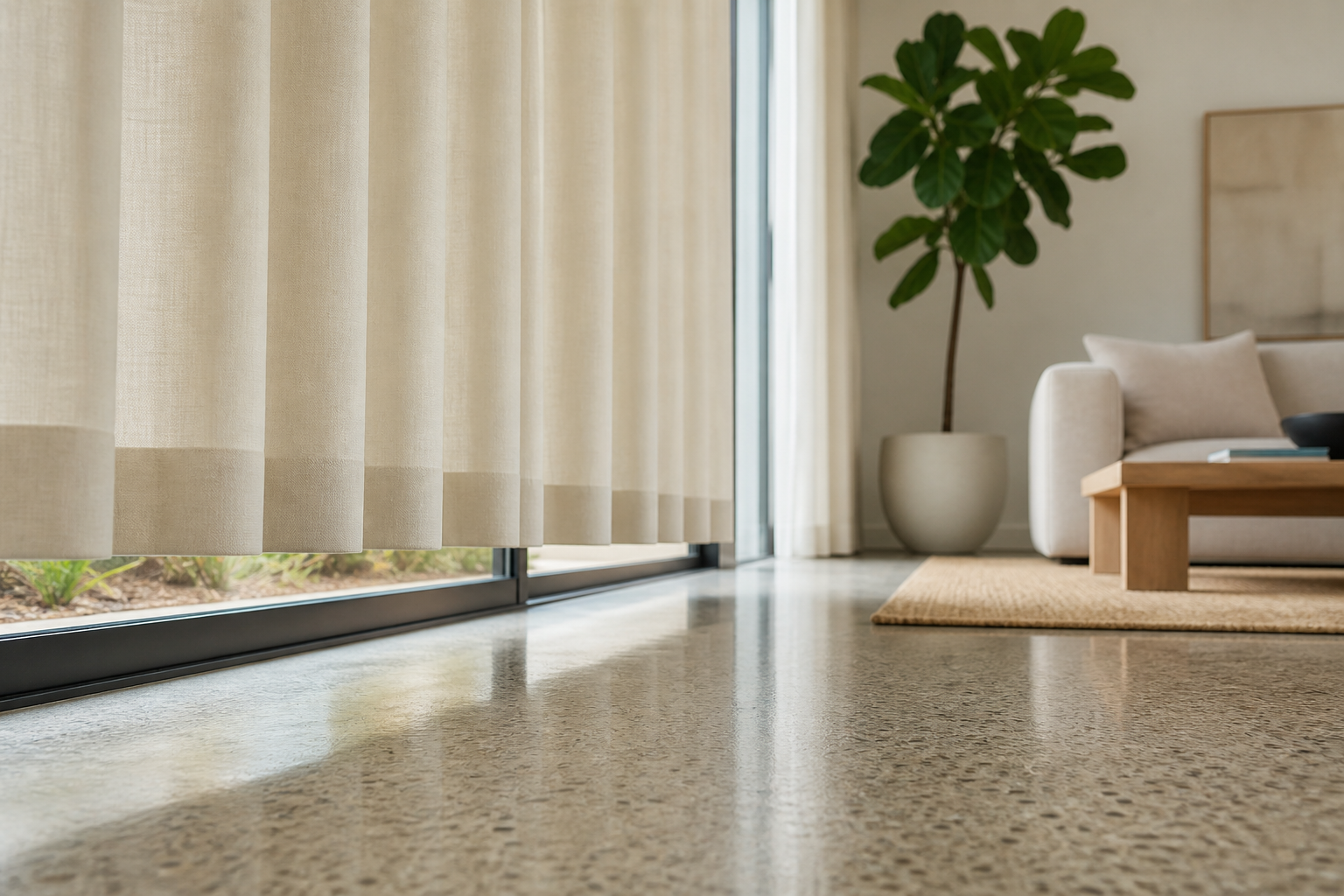
A common consequence of inexperienced specification: curtains hanging short of the floor after fabric shrinkage. An experienced supplier anticipates this movement before the curtain is made. Acceptable for some. Not for Sun Solutions.
Importantly, this is not a fault. It is a normal and expected characteristic of curtain fabrics, recognised across the industry and reflected in the trading terms of every reputable Australian and European fabric supplier.
It's also worth understanding that the 3% figure represents the upper limit of acceptable movement, not the typical outcome. Most fabrics from reputable Australian and European fabric houses move significantly less. Kvadrat, for example, publishes per-fabric data ranging from 1% to 4%, with stable polyester products such as their Site collection moving as little as 1% - around 25mm on a 2.5m drop. Pure linen products sit at the upper end of the range, which is why those linens are specified to puddle on the floor in the first place.
This is what experienced specification is for. A 5-10mm just-off-floor finish on a stable polyester works because the fabric won't move 75mm. A puddle finish on linen works because the fabric will move noticeably, and the puddle absorbs the variance without it being visible. The published 3% defines what's acceptable at the upper end. The job of an experienced supplier is to keep the visible result well below it.
Is There an Australian Standard for Curtain Tolerances?
There is currently no Australian Standard that governs the finished dimensions of curtains.
Australian Standards regulate how fabrics perform, not how a finished curtain must sit once installed. The relevant published Australian Standards for curtain fabrics, all administered by Standards Australia, are:
AS 2663.1-1997 - Textiles: Fabrics for window furnishings, uncoated drapery
AS 2663.2-1999 - Textiles: Fabrics for window furnishings, coated curtain fabrics
AS 2678 - Colourfastness, after-care cleaning, dimensional change due to cleaning, and atmospheric movement
AS/NZS 1530.2 and 1530.3 - Flammability testing for drapery, including ignitability and flame spread
These standards specify how a fabric must perform. They cover UV resistance, abrasion, dimensional stability under specified test conditions, and fire performance. They do not specify how much variance is acceptable between the measurement on your window and the dimensions of the finished curtain that arrives at site.
So where does the standard come from? Two sources: the published guidance of the industry body, and the tolerance positions of the major fabric houses themselves. Reputable suppliers work to both as a minimum. But because these are industry-accepted norms rather than legally-enforceable specifications, suppliers who prioritise short-term margin over long-term client relationships - cutting fabric quantities, sourcing inferior fabric, skipping the technical work - face no formal consequence for ignoring them. The market is full of curtains made this way.
The 3% Curtain Tolerance Rule Explained
The most widely accepted benchmark comes from the Window Coverings Association of Australia (WCAA), which states:
"No fabric is completely stable, it is reasonable to accept approximately 3% movement, depending on the composition of the fabric and climatic conditions."
Source: WCAA Curtain Standards (PDF)
This 3% curtain tolerance is supported across the major Australian and European fabric houses and functions as the de facto industry baseline.
It accounts for:
Manufacturing variation
Fabric settling after installation
Environmental changes such as humidity and temperature
Rather than trying to eliminate movement, experienced suppliers design around it.
A critical qualifier: this 3% consensus applies to fabrics from reputable Australian and European fabric houses with published tolerance data and commercial-grade testing. Cheap fabrics imported from Asia - sold on price alone, with no published tolerance and no manufacturer accountability - sit outside this consensus. Many will move significantly more than 3%, and some will fail in ways no tolerance allowance accommodates.
Why Curtains Move After Installation
Curtains continue to move after installation due to several factors.
1. Environmental Conditions
Curtain fabrics respond to:
Humidity
Temperature
Heating and cooling systems
In climates like Perth, seasonal variation can influence how fabrics behave throughout the year.
2. Fabric Composition
Different fibres respond differently:
Polyester curtains - highly stable with minimal movement
Blended fabrics - moderate movement
Natural fibres such as linen and cotton - higher movement
3. Fabric Construction
Movement is also influenced by:
Weave structure
Fabric weight
Finishing processes
How Australia's Major Fabric Houses Publish Tolerance
The strongest evidence of the 3% curtain tolerance benchmark comes from the major fabric suppliers themselves. Each publishes its own position on fabric movement, and the consistency across them is what gives the industry its working standard.
Charles Parsons Interiors
Charles Parsons publish care labels covering their full range of curtain fabrics. Across all of them, the published shrinkage position is consistent: "Possible shrinkage 3%."
Source: charlesparsonsinteriors.com.au/pages/care-labels
Warwick Fabrics
Warwick state the industry position most directly in their published guidance:
"All fabrics are prone to shrinkage and it is important that sufficient allowances be made. An allowance of 3% is considered an acceptable industry standard."
Source: Warwick Fabrics, Helpful Tips
Warwick also test their drapery fabrics for Colourfastness to Hanging under AS 2663.1.B, measuring movement, both shrinkage and stretch, in the warp and weft directions. These results are published on every fabric's individual specification sheet, allowing specifiers to assess dimensional behaviour before commitment.
Zepel Fabrics
Zepel's Trading Terms explicitly acknowledge post-installation movement:
"Depending on fibre content, there will always be some movement in drapery length due to changes in temperature and the absorption and release of moisture from the yarns in the fabric. The longer the drapery, the greater the movement."
Zepel additionally specify that fabrics with a horizontal pattern allow up to 3cm tolerance for bowing - a separate, less-discussed manufacturing tolerance that affects pattern alignment in joined drops.
Source: zepelfabrics.com/about/terms
Kvadrat
Danish manufacturer Kvadrat, available in Australia through commercial specification channels like Sun Solutions, publish detailed per-product tolerance data. Every individual fabric specification page lists shrinkage broken down by warp and weft separately, with published values ranging from 1% to 4%.
Source: kvadrat.dk/en/products/curtains
Basford Brands (Filigree)
Filigree state their product specifications are "aimed to exceed Australian and New Zealand Standards."
Source: basfordbrands.com
Linen Curtains - Where Tolerance Becomes Critical
If there's one material where curtain shrinkage becomes more noticeable, it's linen.
Linen curtains have surged in popularity in recent years. Their texture, natural drape and organic aesthetic are unmatched by synthetic alternatives, and clients increasingly specify linen for premium residential and commercial projects. But linen's behaviour also makes it the fabric where less-experienced suppliers most commonly fail - usually through mis-measurement, where curtains end up pooling fabric where they should hang straight, or hovering above the floor where they should puddle.
Why linen is different. Linen is hygroscopic. The flax fibre absorbs and releases moisture from the surrounding atmosphere far more readily than synthetic yarns. In a humid Perth summer, or a dry winter morning with the heater on, a 100% linen curtain will breathe, expand, contract, and continue moving for the life of the product.
What manufacturers say. Warwick state explicitly that "some fibres are prone to movement such as 100% linen and should be seen as a characteristic that can be managed with the drapery style such as puddling hems."
Zepel describe their 100% linen sheer Pure Linen as a fabric that "drapes elegantly and puddles with shapely form on the floor due to its textured weight." This is designed-in puddling, not a treatment of a flaw.
Kvadrat are explicit on this point. On multiple linen and natural-fibre products, the manufacturer instruction is "the curtain shall touch the floor when hanging." This is not a recommendation. It is a manufacturer-stated condition.
The practical consequence. A 100% linen curtain specified to hang 10mm above the floor will, in normal residential conditions, sometimes touch the floor and sometimes hover above it. The supplier who designs for this - specifying a puddle finish, sourcing from fabric houses with published per-product data rather than generic disclaimers, and measuring with the experience to anticipate movement - is the supplier who delivers a curtain that performs over years rather than months.
Why Experience Matters in Curtain Tolerances
This is where the difference between suppliers becomes clear.
Two suppliers can work with the same fabric, but without a clear understanding of curtain shrinkage, fabric movement, and installation conditions, the final result can vary significantly.
Experience determines:
Which fabrics are specified for which applications
How measurements are taken
How finishes are designed to accommodate movement
Where to source from, and where not to
Without this, even high-quality fabrics can produce poor outcomes.
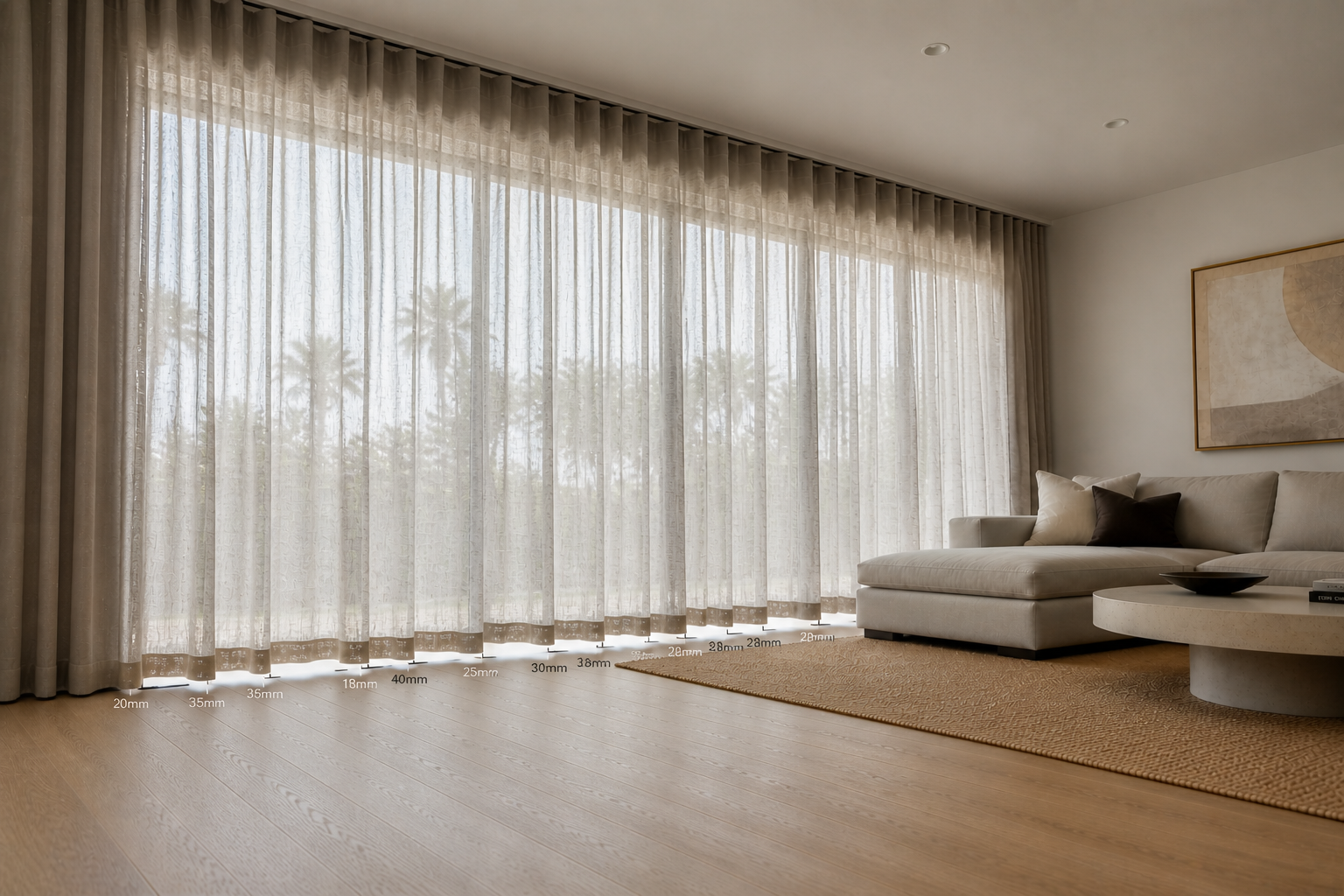
The visible result of inadequate tolerance specification across a wide window run - uneven hems where the fabric has moved differently along its length. Acceptable for some. Not for Sun Solutions.
How Sun Solutions Manages Curtain Tolerances
The practical decisions that determine whether a curtain performs for years or fails within months - fabric selection, finishing style, measurement, supplier sourcing - are decisions we make for our clients on every project. When you engage Sun Solutions, you don't need to know which fabric suits which application or what finishing style works with which fibre. That's our expertise to apply, not yours to learn.
Here's how we apply it:
We specify for stability where the application demands it. Linen-polyester blends, polyester linen-look fabrics, and triple-weave constructions deliver the linen aesthetic with synthetic stability. Where movement would compromise the finished product, we steer clients toward these fabrics, not away from a look they want.
We match finishing style to fabric. Just-off-the-floor (5-10mm) is the right specification for stable polyester drapery. Puddle finishes are correct for 100% linen and high natural-fibre blends. Generic finishing isn't part of our process.
We measure with experience. Linen and natural-fibre curtains in particular reward measurement experience and punish its absence. Our 20+ years means we anticipate how each fabric will behave when we measure - so the finished curtain delivers the look the client specified, not an approximation of it.
We source from suppliers with published tolerance data. Every fabric we specify comes from a named Australian or European fabric house with documented tolerances we can read and reference. We don't rely on generic catalogues or cheap imports.
We bridge the gap between fabric tolerance and finished curtain performance. No published Australian Standard governs the finished product. Our competence - across fabric specification, custom curtain manufacture and accurate measurement - is what closes that gap.
The Quiet Difference
Most of what makes a curtain look right or look wrong is decided long before the fabric reaches the workroom. It's decided when the supplier chooses where to source from. It's decided when the supplier specifies a fabric for a particular application. It's decided when the supplier measures, knowing how that specific fabric will respond to Perth's climate over the seasons that follow.
By the time a client sees the finished curtain, the work that determines whether it will perform is already done - or already not done. At Sun Solutions, we've spent more than 20 years doing it. We source only from reputable Australian and European fabric houses that publish their tolerance data. We specify against that data. We measure for fabrics that move. The 3% industry tolerance is where our work begins, not where our explanations begin.
Book a Curtain Consultation
When it comes to custom curtains, the difference isn't just the fabric - it's the experience behind how it's specified, measured and installed.
Not all curtains are created equal - and the supplier you choose plays a critical role in how they perform over time.
If you're planning curtains in Perth, book a design consultation with Sun Solutions to ensure the right outcome from day one.
FREQUENTLY ASKED QUESTIONS
-
Curtains can move by up to approximately 3% in length under industry consensus, which equates to 75-90mm depending on the curtain drop. This is the upper limit of acceptable movement, not the typical outcome - most fabrics from reputable Australian and European fabric houses move significantly less.
-
No. Fabric movement is a natural and expected characteristic and is accepted across the industry, including by the Window Coverings Association of Australia and every reputable fabric supplier.
-
Yes. Linen is hygroscopic - it absorbs and releases moisture from the surrounding atmosphere more readily than synthetic yarns. Linen curtains expand in humid conditions and contract in dry conditions, and continue to move over time.
-
Curtains can be manufactured precisely, but fabric behaviour means they may change once installed. Experienced suppliers measure with movement in mind and specify finishing styles that accommodate it, rather than promising precision the fabric cannot deliver.
-
Curtains respond to environmental conditions such as temperature, humidity, and seasonal change. Natural fibres respond more than synthetics, and longer drops show more movement than shorter ones.
-
No. Australian Standards (AS 2663, AS 2678, AS/NZS 1530) regulate how curtain fabrics perform - covering UV resistance, dimensional stability under test conditions, and fire performance - but do not specify acceptable tolerances for finished curtain dimensions. The industry baseline of 3% movement comes from the Window Coverings Association of Australia and is supported by the published positions of the major fabric houses.