
S-Wave Curtains Explained - Understanding This Modern Curtain Heading
What Are S-Wave Curtains?
S-Wave curtains - also referred to as S-Fold or wave-fold curtains - are not defined by fabric, but by the way the curtain is constructed and hangs.
They are a curtain heading system designed to create a smooth, continuous wave across the full width of the track. This style is commonly specified across modern homes and apartments and is widely used for custom curtains in Perth where a clean, consistent finish is required.
While the end result appears simple, achieving a true S-Wave finish relies on the correct combination of system, spacing and installation.
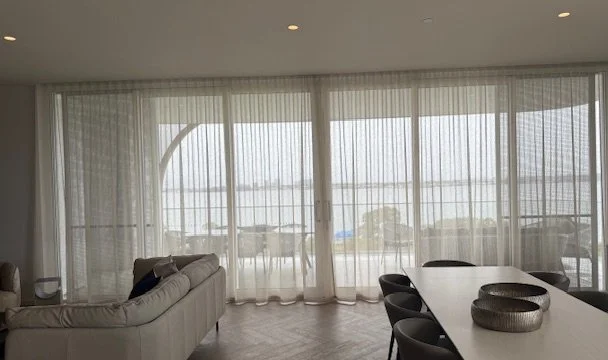
S-Wave curtains create a soft, continuous wave across the full width of the window, delivering a clean and consistent finish.
What Is a Curtain Heading?
In interior design and curtain specification, the heading determines how the fabric is distributed, how it stacks, and how it presents when open and closed.
Different heading systems create completely different visual outcomes, even when using the same fabric. This is why the heading is a critical consideration when selecting curtains in Perth, particularly for large openings or architectural spaces.
In practice, the heading is what defines the final result - not just the material itself.
What Defines an S-Wave (S-Fold) Curtain
An S-Wave curtain is defined by a controlled system that dictates how the fabric falls.
Key characteristics include:
Fixed spacing between carriers
Controlled distribution of fabric
A consistent forward-back wave pattern
A uniform appearance when open and closed
The result is a structured, repeatable wave formation across the entire curtain.
Because the wave is consistent across the full width, any variation in spacing or alignment becomes immediately noticeable.
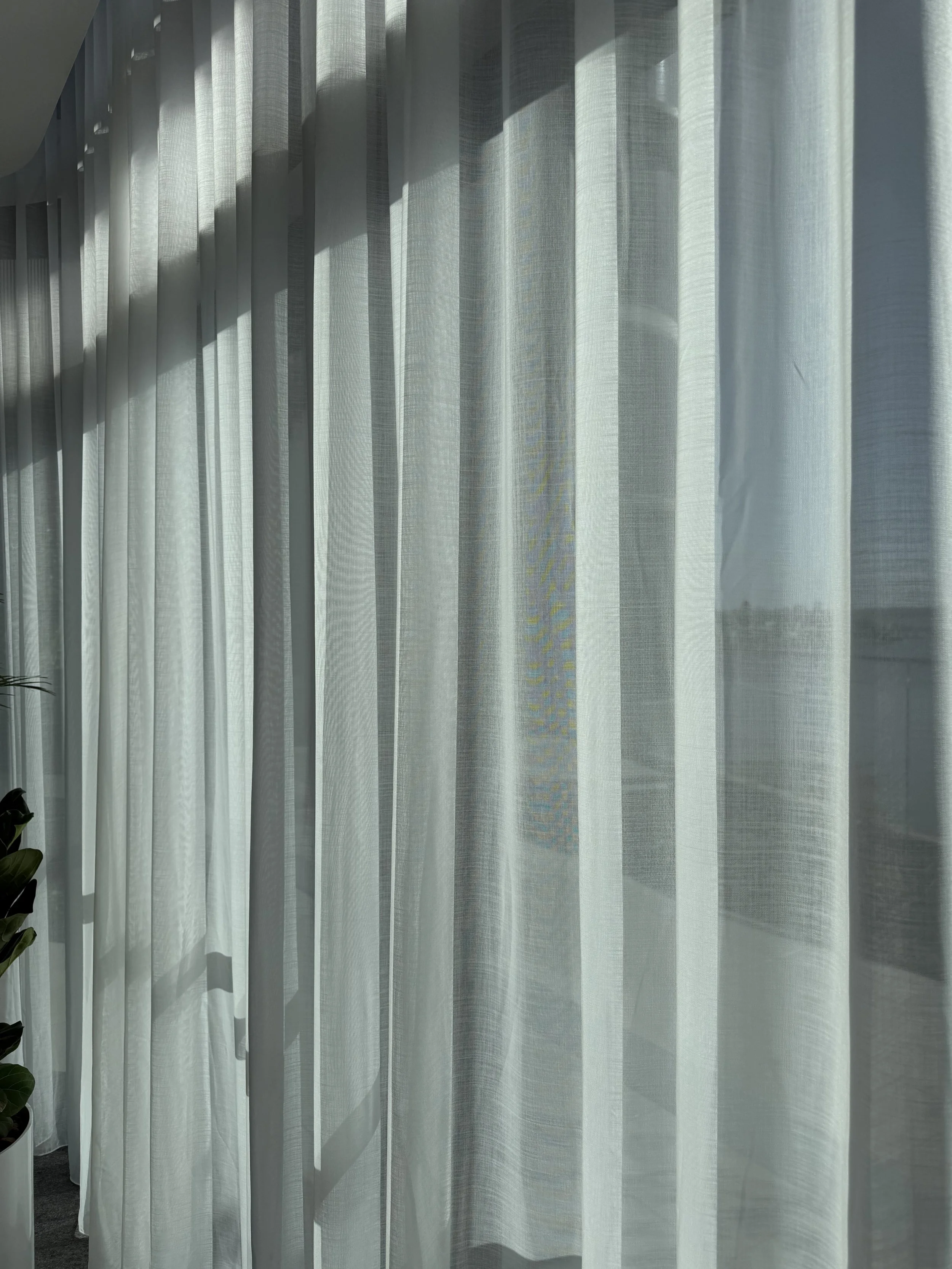
The uniform wave pattern is created by fixed spacing within the track system, ensuring consistent folds across the curtain.
Are S-Wave and S-Fold the Same Thing?
S-Wave and S-Fold are two terms used within the industry to describe the same style of curtain heading - a continuous wave formation created by a track-based system.
In interior design and specification language, the terms are often used interchangeably. However, the exact construction, including the track system, carriers and heading tape, can vary depending on the manufacturer or installer.
How the System Works
The S-Wave effect is created by a specialised track system designed to control how the curtain is distributed across the opening.
Fixed carrier spacing within the track determines the distance between each fold, while the heading tape controls how the fabric moves forward and back as it travels along the track.
Unlike traditional curtains, where folds are manually formed or gathered, the wave pattern in an S-Wave system is engineered into the hardware itself.
This is why accurate track configuration, spacing and installation are critical to achieving a clean, consistent finish.
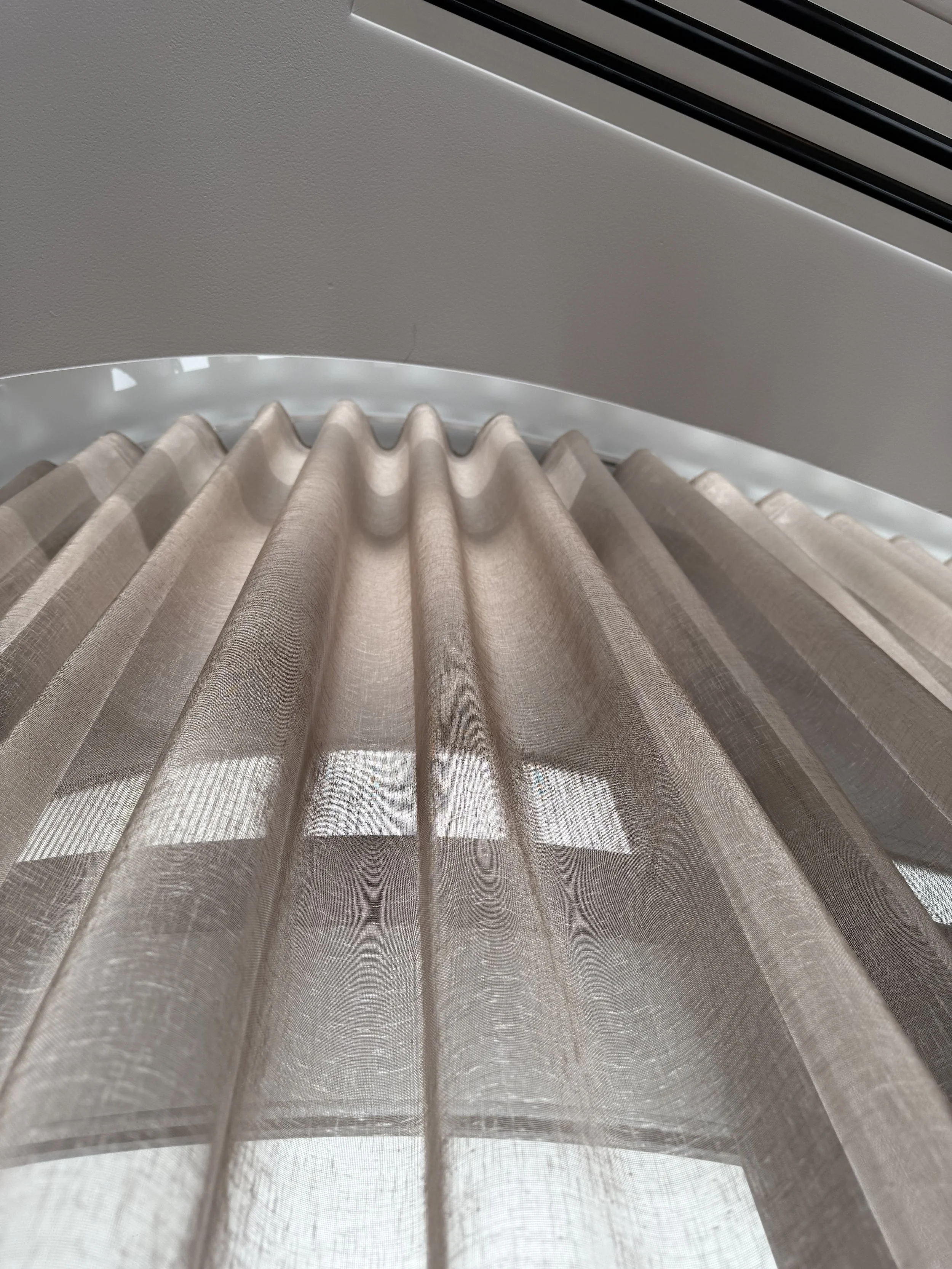
S-Wave curtains rely on a specialised track system with fixed spacing to maintain a consistent wave formation.
Planning S-Wave Curtains for Your Home?
The success of an S-Wave curtain system depends on more than just selecting a fabric or track. Proportions, layout, window dimensions and stack requirements all influence the final result.
If you’re planning custom curtains in Perth, we can help you determine the most appropriate solution for your space.
Book a design consultation with Sun Solutions to discuss your project →
How S-Wave Curtains Differ from Traditional Pleated Headings
Traditional pleated curtain headings, such as pencil pleat or pinch pleat, create defined sections of gathered fabric across the width of the curtain.
By comparison, S-Wave curtains form a softer and more continuous line, resulting in a cleaner and less segmented appearance.
This difference changes how the curtain behaves both when open and closed.
When open:
S-Wave curtains typically stack in a more streamlined manner
The folds remain more evenly spaced rather than compressing into dense pleats
The overall stack is generally less bulky within the opening
When closed:
The curtain maintains a consistent rhythm across the width
The wave pattern appears more continuous and uniform
The fabric sits in a forward-back formation rather than flattening into segmented sections
Because the wave is controlled by the system itself, the curtain maintains a more consistent form regardless of its position.
As a result, S-Wave headings are often preferred in contemporary spaces where a cleaner and more architectural finish is desired.
Curtain Heading Comparison - S-Wave vs Traditional Styles
| Feature | S-Wave (S-Fold) | Pinch Pleat | Pencil Pleat |
|---|---|---|---|
| Appearance | Smooth, continuous wave | Structured, tailored pleats | Soft, gathered look |
| Visual consistency | Uniform across full width | Defined pleat intervals | Variable depending on gather |
| Stack (when open) | Controlled and less bulky | Bulkier due to fixed pleats | Can bunch unevenly |
| Closed appearance | Continuous wave pattern | Segmented pleat sections | Relaxed and less structured |
| Best for large openings | Excellent | Moderate | Limited |
| Track system | Specialised track with fixed spacing | Standard track with hooks | Standard track with adjustable gather |
| Precision required | High | Moderate | Lower |
| Tolerance to errors | Low - inconsistencies are noticeable | Moderate | More forgiving |
| Typical application | Modern, architectural spaces | Traditional or formal interiors | General residential use |
Visual Impact on the Space
S-Wave headings also influence how the window is perceived within the room.
The continuous vertical wave, combined with full-height installation, can:
Emphasise the height of the space
Create a more seamless connection across wide openings
Reduce visual interruption compared to more segmented curtain styles
In practice, this can make openings feel more expansive from within the room - particularly where curtains extend from ceiling level and run wall-to-wall.
As with all curtain systems, the effectiveness of this result depends on how well the spacing, proportions and installation are resolved.
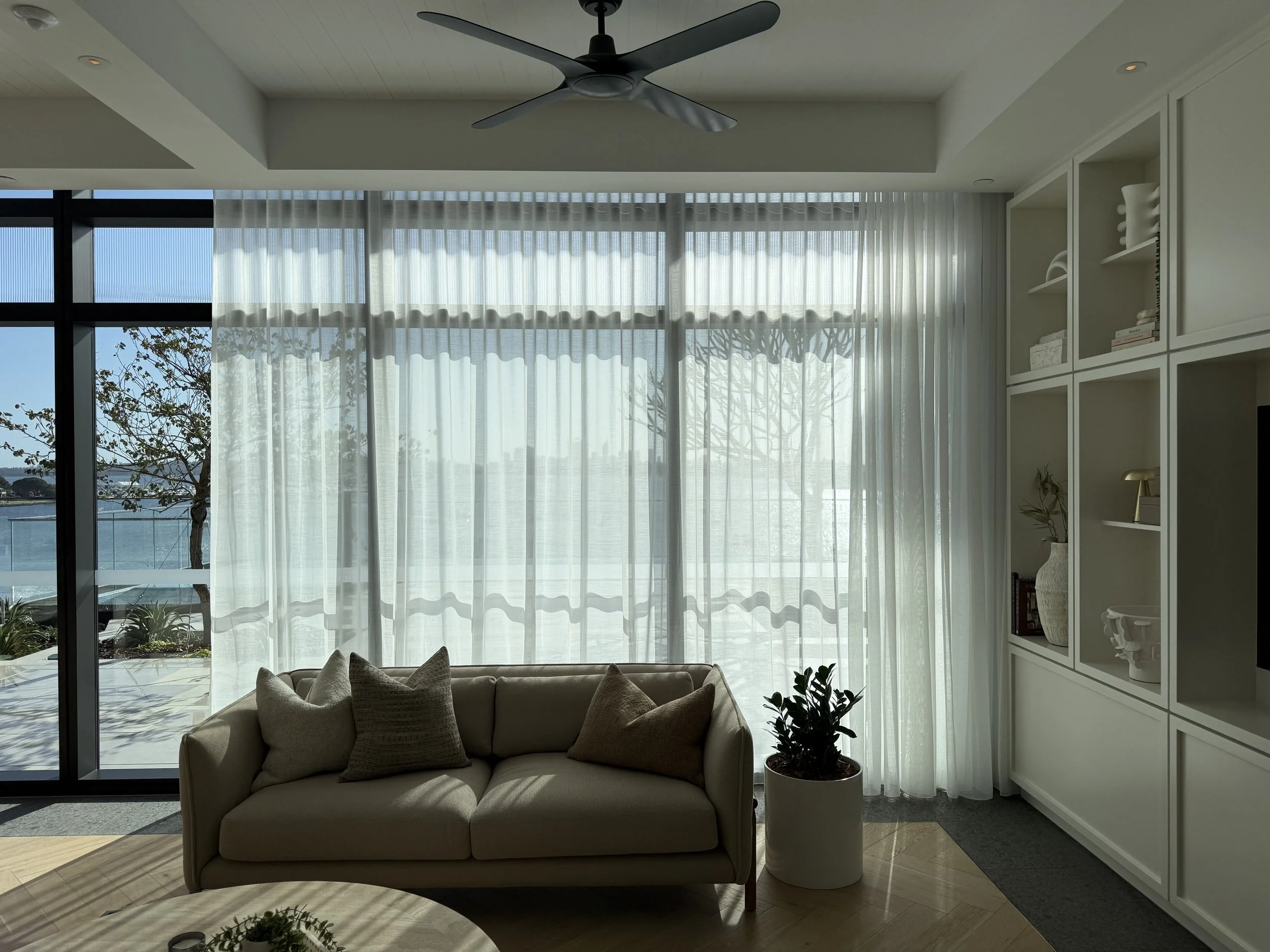
S-Wave curtains maintain a consistent rhythm across wide openings, making them ideal for large windows and sliding doors.
Where S-Wave Curtains Work Best
S-Wave headings are particularly well suited to:
Sliding doors
Floor-to-ceiling windows
Long wall-to-wall openings
Open-plan living spaces
They are commonly used with both sheer and blockout curtains, depending on the level of light control and privacy required.
In these applications, maintaining alignment and consistency across the full width of the opening is critical to the final finish.
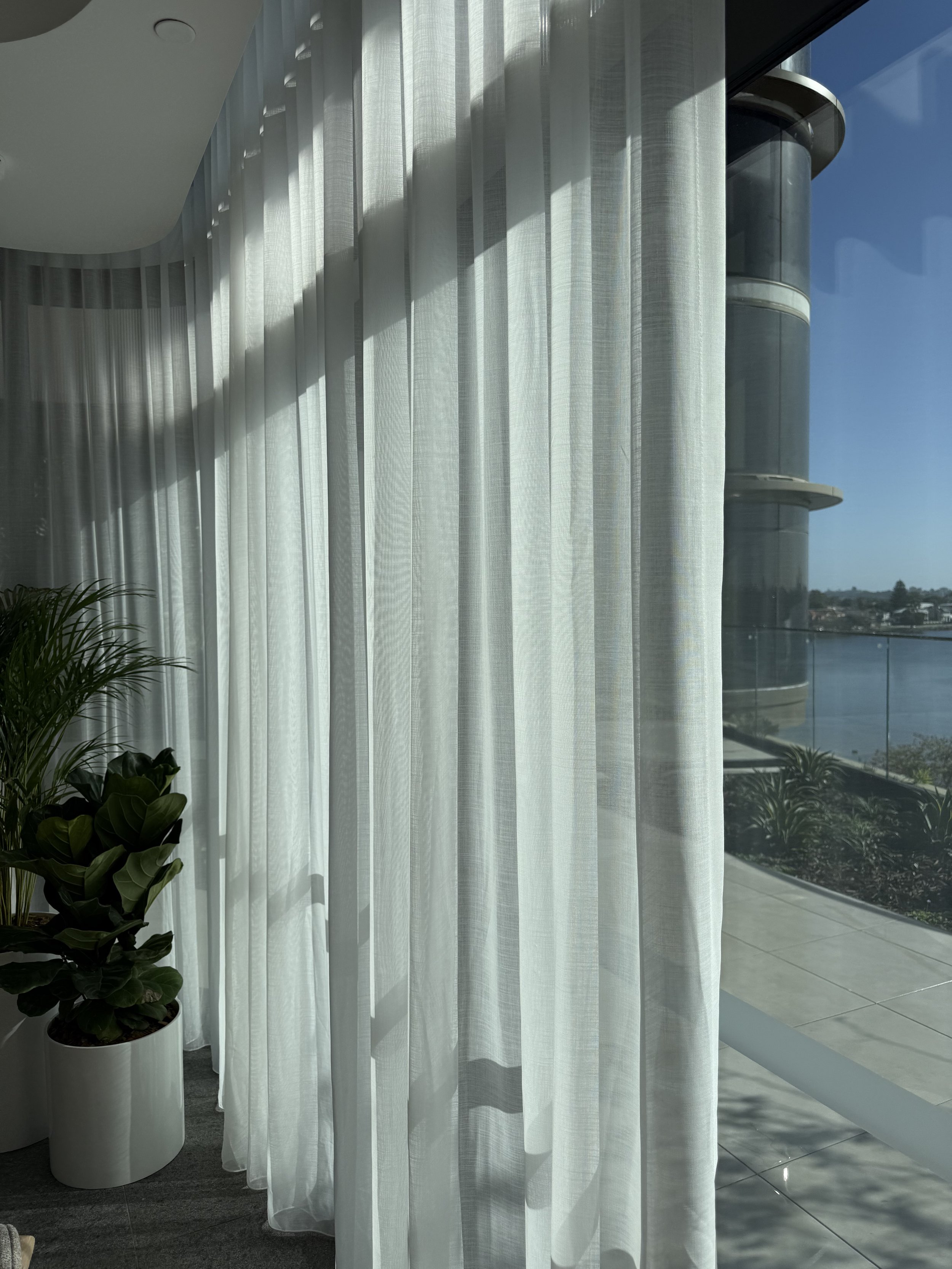
The consistent forward-back wave creates depth and softness without interrupting the overall line of the window.
Not All S-Wave Curtains Are Created Equal
Not all S-Wave curtains are created equal - and neither are the systems and expertise behind them.
Because S-Wave curtains follow a consistent and highly visible pattern across the full width of the opening, even minor inconsistencies can affect the final appearance.
Common issues can include:
Uneven folds across the width
Bulky or poorly resolved stack-back
Misalignment at the base of the curtain
Inconsistent spacing from one section to the next
These details become particularly noticeable across large openings, floor-to-ceiling installations and wall-to-wall applications where continuity is critical to the final finish.
While the overall look may appear effortless, achieving a clean and balanced result depends on the quality of the system, the accuracy of the setup and the standard of installation.
This is where the difference between standard and well-executed curtains becomes clear - particularly in projects where consistency, scale and finish matter.
Frequently Asked Questions About S-Wave Curtains
-
S-Wave and S-Fold refer to the same style of curtain heading, with terminology varying depending on supplier or specification.
-
S-Wave creates a continuous wave, while pinch pleat uses structured folds, resulting in a more segmented appearance.
-
Yes, they are ideal for large spans as they maintain a consistent rhythm across the width.
-
Generally, yes. They stack more evenly and with less bulk than pleated curtains.
-
Light control depends on the fabric, not the heading system.
-
Yes, they rely on a track with fixed spacing to create the wave formation.
-
Yes, they require precise measurement and installation due to their uniform structure.
Final Thoughts
S-Wave (or S-Fold) curtains are one of the most precise curtain heading systems available. While they appear simple, the final result is entirely dependent on how well the system is specified, manufactured and installed.
For homeowners and designers considering curtains in Perth, understanding how the heading system works is just as important as selecting the right fabric - particularly when the goal is a consistent, architectural finish.
To see how S-Wave curtains are applied across different spaces, explore our full range of custom curtains in Perth
If you’re planning a project and want to ensure the system, spacing and installation are resolved correctly from the outset, we can help. Book your curtain design consultation with Sun Solutions →