
Window Covering Trends 2026: What's Shaping Australian Homes This Year
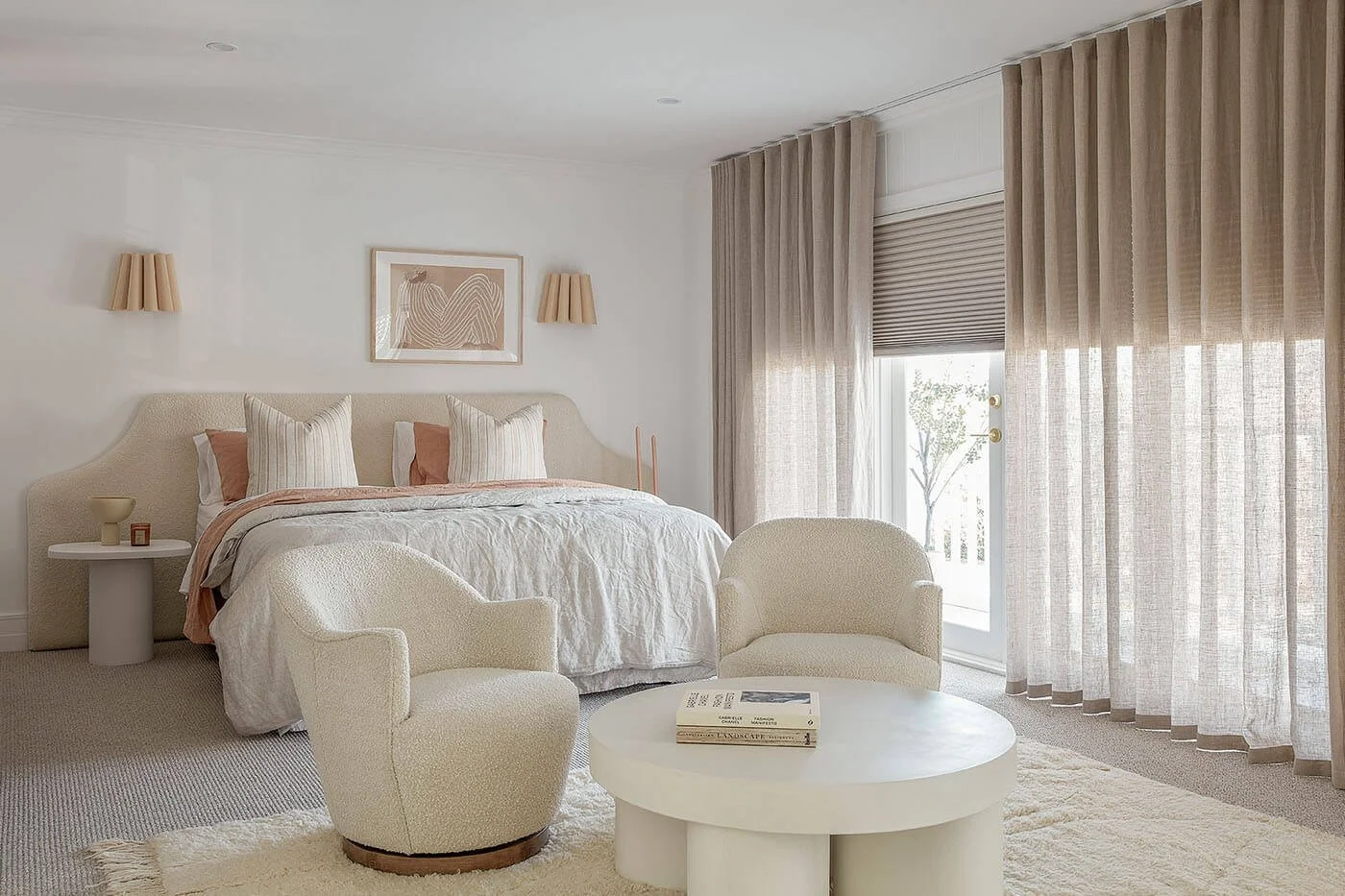
Layered window coverings define 2026 specification: S-Wave sheer curtains in warm sandstone linen filter daylight, while Hunter Douglas Duette blockout blinds beneath provide true light and privacy control in this contemporary Australian bedroom.
Australian interiors have moved decisively away from cool minimalism in 2026. Designers, architects and discerning homeowners are reaching for warmth, layering, tactility and quiet automation, and window coverings are central to how that shift is being expressed. After more than 20 years specifying blinds, curtains, shutters and outdoor awnings across Perth and Western Australia, Sun Solutions has watched the mood change room by room. This guide pulls together what is genuinely shaping the category in 2026, drawing on supplier intelligence from Hunter Douglas and Luxaflex, designer commentary from across the Australian industry, and the projects we are quoting and installing right now.
The bigger picture: how 2026 Australian interiors are shifting
The most authoritative summary of the 2026 mood comes from Luxaflex Australia's window treatment trends article, which describes a year that "embraces a richer, more tactile design language across every room of the home" after several seasons of minimalism and quiet luxury (Luxaflex Australia, accessed May 2026). The Stylesmiths Australia, in their January 2026 trends piece, frame the shift as "warm minimalism, interpreted for Australian living — minimalism in Australia is evolving... warmer, softer, and more human, defined by clean architectural lines balanced with tactile materials and relaxed comfort" (The Stylesmiths, 29 January 2026).
This direction was echoed at the top of the Australian design industry. In Broadsheet's February 2026 trends feature, Hecker Guthrie co-founding principal Paul Hecker observed that "style doesn't date, but poor execution does," arguing for "a return to heritage... not in a nostalgic or overly traditional way, but through the thoughtful reimagining of classic pieces" (Broadsheet, 3 February 2026). Decorator Simone Haag, in the same article, said: "In 2026, I'm drawn to interiors that are rooted in craft, texture, narrative and a relaxed but resolute elegance — environments that make you stay longer and feel genuinely at home" (Broadsheet, 3 February 2026).
The implication for window coverings is direct. The product categories that are gaining ground are the ones that allow for layering, texture and quiet performance — and the ones that lend themselves to thoughtful, considered specification rather than disposable trend-chasing.
Sheer curtains: still the defining trend
If a single product defines Australian residential design in 2026, it is the sheer curtain. Australian search behaviour confirms it — sheer curtains are by a significant margin the most-searched window covering term in the country. The product is in its second decade of dominance and shows no sign of fading.
What has changed is the fabric direction. Linen and linen-blend sheers are the clear preference for premium specification in 2026. Luxaflex Australia notes that "linen and linen-blend fabrics are gaining strength across both blinds and drapery thanks to enhanced drape and crease resistance" (Luxaflex Australia, accessed May 2026). The slubby, hand-finished texture of a quality European linen sheer carries the tactility that Hecker, Haag and the broader 2026 design conversation are pointing to.
Luxaflex National Brand Partner and interior design expert Neale Whitaker, writing in Central Western Daily, has described the role of the sheer in contemporary Australian living: "In the main living area, floor-to-ceiling sheer curtains filter and diffuse the light whilst allowing full access to the view" (Central Western Daily, 2022). The view-plus-light-control logic he sets out has only become more relevant as Australian homes have opened up further to their gardens and outdoor rooms.
For a closer look at the fabric science behind sheer specification, our guide to fabric opacities walks through how sunscreen, translucent, room-darkening and blockout fabrics each perform differently — essential reading before committing to a sheer-only or layered scheme.
Curtain headings: S-Wave becomes the standard
The curtain heading question is where 2026 separates itself most cleanly from older Australian residential design. S-Wave — also called S-Fold or wave fold — is now the dominant modern heading. It produces a uniform, architectural ripple that suits open-plan rooms, ceiling-mounted tracks and contemporary fabric weights.
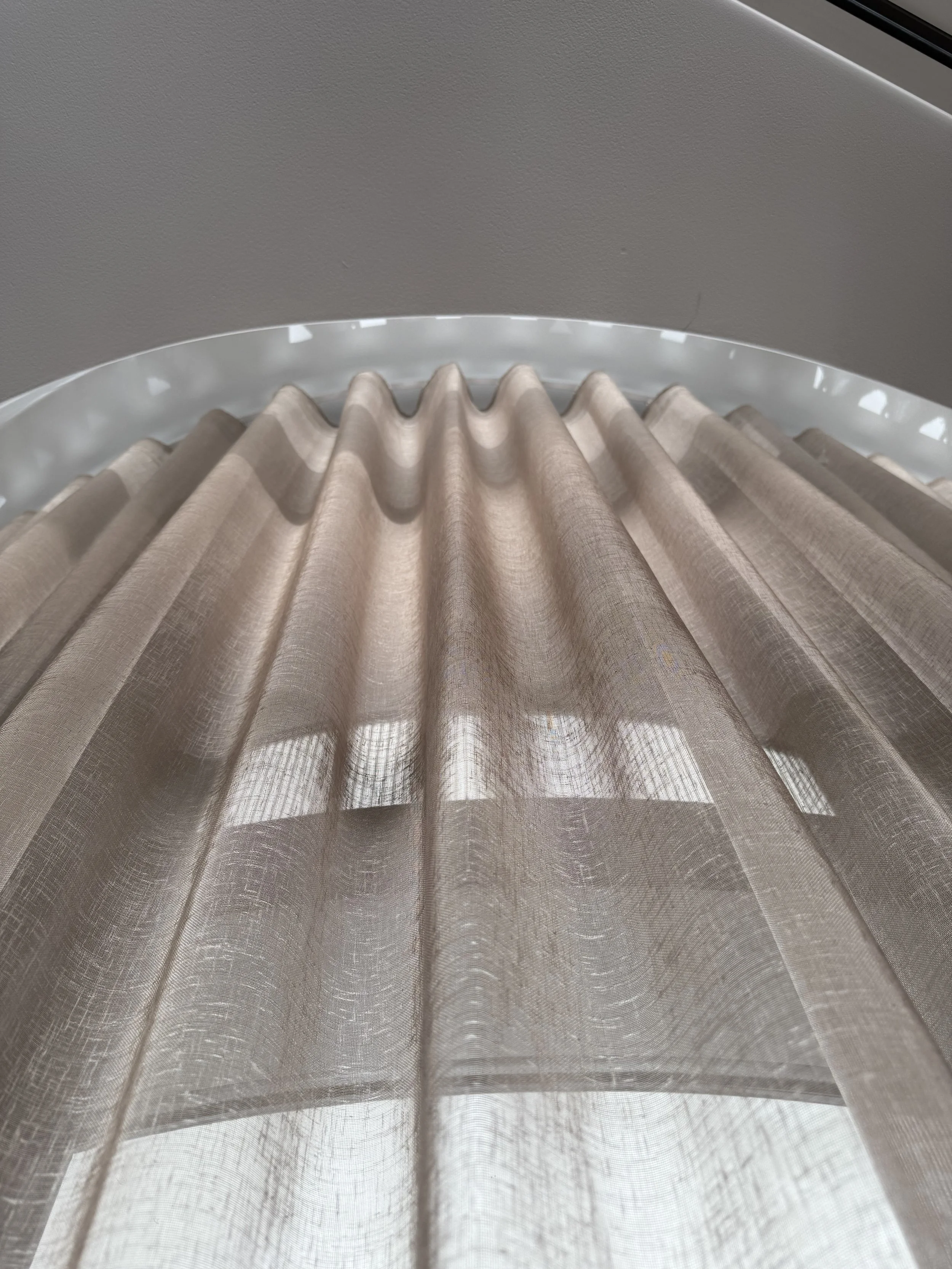
S-Wave heading detail from the Riviere Residences East Tower project - the uniform wave fold has become the dominant modern curtain heading specification for premium Australian apartment developments in 2026.
Pinch pleat, by contrast, reads as traditional. It is not a 2026 trend. Australian House & Garden's Kate Nixon framed the distinction cleanly in Dressed to Thrill: "An inverted box pleat or S-fold is great for a contemporary finish, or opt for a classic double or pinch pleat for a traditional aesthetic" (Australian House & Garden, January 2022). Four years on, that observation has hardened into industry consensus. The premium residential and apartment developer projects Sun Solutions specifies in 2026 are overwhelmingly S-Wave.
S-Wave is a system, not just a heading style — track, glide, fabric weight and stack space all need to be specified together to achieve a clean, consistent finish. Our explainer on S-Wave curtains walks through how the system works and why correct specification matters: "S-Wave curtains... are one of the most widely used modern curtain headings... correct specification is critical to achieving a clean, consistent finish."
Cellular and honeycomb blinds: the performance trend
The cellular blind — also called honeycomb blind, with Hunter Douglas's Duette range as the category benchmark — has had a notable 2026 resurgence. Australian search demand for honeycomb and cellular blinds sits among the highest-volume product queries in the country, and the reasons are structural rather than cosmetic. The pleated double-cell construction traps air, providing genuine thermal insulation in both directions: holding heat out in summer and warmth in during winter. Luxaflex Australia describes Duette specifically as "engineered to create insulation and lower energy bills by trapping air in distinct pockets," and positions cellular shades among the year's most-specified performance products (Luxaflex Australia, accessed May 2026). For Perth and Western Australian homes contending with strong west-facing sun, the thermal case has only strengthened as energy costs have risen.
Visually, cellular blinds have moved with the broader 2026 colour story. The flat, paper-pale tones of earlier cellular ranges have given way to richer naturals — sand, oatmeal, soft mushroom, sage and warm cream — that sit comfortably alongside linen sheers. Layering a Duette under floor-to-ceiling sheers is one of the year's most-requested combinations in our showroom and on builder specifications.
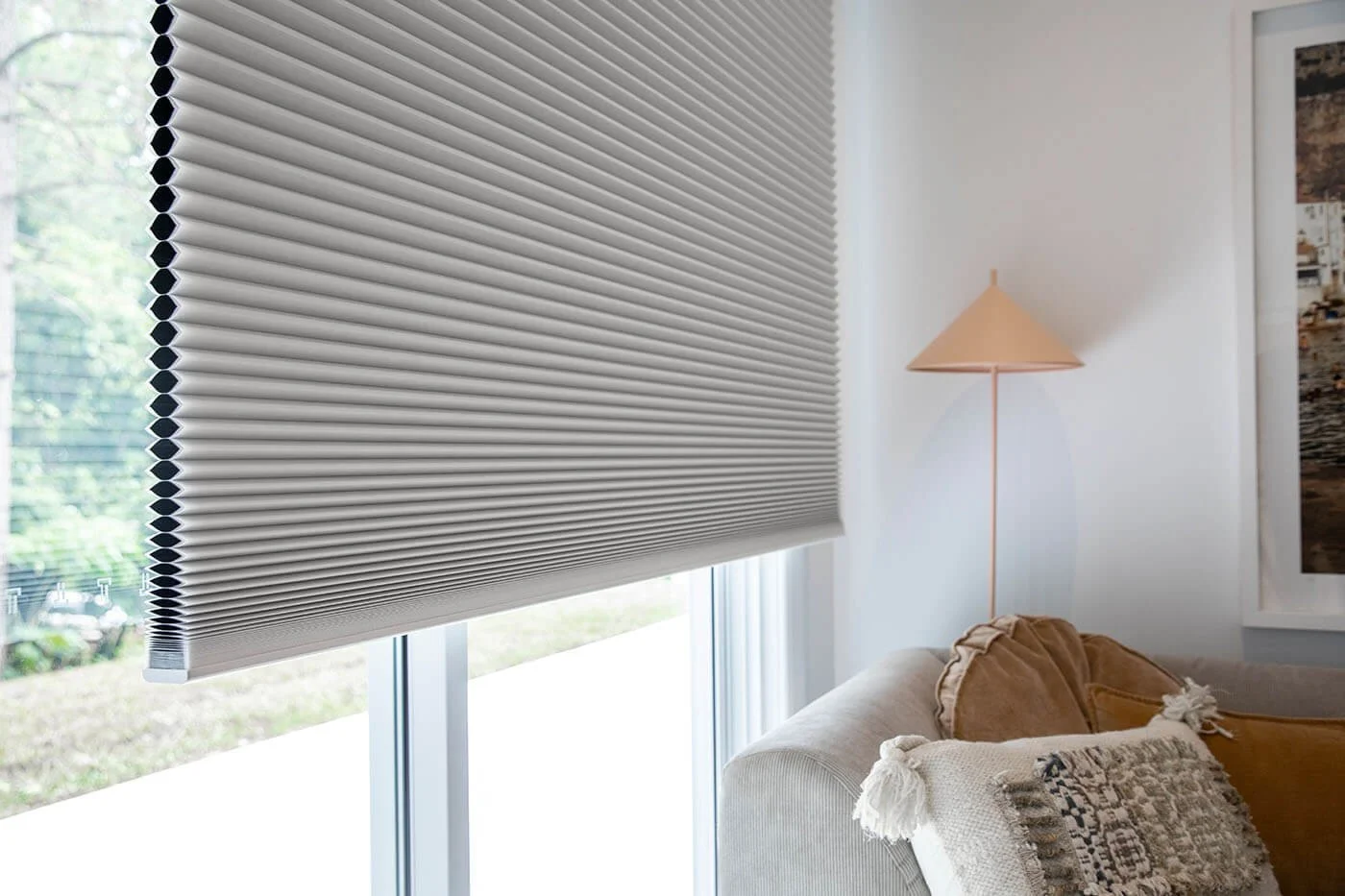
The double-cell side profile of a Hunter Douglas Duette honeycomb blind. The trapped air pockets between cells deliver genuine thermal insulation, holding heat out in summer and warmth in during winter - the structural reason cellular blinds have become a 2026 performance specification.
For the technical detail on layering combinations like this — including the four pairings we use most often — our layering guide is the place to start: "Layering curtains and blinds can transform your home with better light control, enhanced privacy, and a sophisticated designer finish."
Plantation shutters: Australian-made returns to centre stage
Plantation shutters have stayed remarkably durable across multiple cycles of Australian design. In 2026, the renewed interest is being driven by two parallel forces: the return-to-heritage thread that Hecker pointed to in Broadsheet, and a broader Australian-made specification preference among architects and apartment developers.
The shutters Sun Solutions specifies most often — Hunter Douglas Luxaflex PolySatin and timber ranges — are made in Queensland for Australian conditions, with a 20-year warranty on PolySatin against warping, cracking, fading and discolouration. That durability case has become a stronger commercial argument as developers and homeowners look for window coverings that survive Perth's UV and coastal salt without the constant replacement cycle of cheaper imports.
The colour direction has also shifted. The bright, glossy white of earlier shutter installations has given way to off-whites, warm whites and considered timber stains that align with the year's softer overall palette. Matte and satin finishes are replacing high-gloss across the category, reflecting the broader move away from reflective surfaces in 2026 interiors.
Our plantation shutters buying guide covers the quality differences in detail: "Not all plantation shutters are built the same. Discover how to choose long-lasting, quality shutters for your Perth home or business."
Smart and motorised: from luxury to standard
Motorisation has crossed an important threshold in 2026. It is no longer specified as a luxury upgrade — it is increasingly a baseline expectation, particularly on hard-to-reach windows, large-format glazing and apartment developer projects. Luxaflex Australia confirms the shift: "Smart window coverings continue to grow in popularity as well, evolving from a feature of convenience into an expected part of modern homes. Quieter motors, intuitive controls and automation that adapts to routines are becoming essential" (Luxaflex Australia, accessed May 2026).
Whitaker has been signalling this direction for several years. Writing for Houzz Australia, he observed that "technology has become integral to design, whether it's asking Alexa for the daily weather report or a coffee table that charges our smart devices. Automated window coverings, lighting and heating are now elements of that" (Houzz AU). What was forward-looking commentary in 2021 has become standard specification practice in 2026.
The technical reality has improved markedly. Battery-powered motors now deliver multi-year run times between charges, eliminating the wiring complications that previously made retrofitting difficult. Wind and sun sensors trigger automatic responses. Integration with home automation platforms — Google Home, Apple HomeKit, Control4 — means window coverings can sit inside the same scheduled and scene-based control as lighting, climate and security.
Lea Design Studio, writing on 2026 Australian residential architecture trends, lists "automated external blinds (Somfy, Luxaflex) for heat management" among the essential smart-home specifications for new builds (Lea Design Studio, 6 February 2026).
Our motorisation overview covers the Hunter Douglas PowerView system and the broader motorisation options Sun Solutions specifies for residential and commercial projects.
Outdoor living becomes architecture: motorised awnings as standard
The most significant shift in the broader window covering category for 2026 is happening outside the building envelope. Indoor-outdoor flow is no longer being treated as a feature — it is being designed as the defining gesture of the contemporary Australian home.
The Stylesmiths Australia frame the shift in their 2026 trends piece: "Indoor-outdoor living has long been part of the Australian lifestyle, but in 2026 it evolves into a more refined, holistic design approach. The focus is on continuity, spaces that flow effortlessly without feeling forced or seasonal" (The Stylesmiths, 29 January 2026).
SE Building Solutions, writing on Brisbane luxury renovations, describe it bluntly: "One of the biggest shifts in 2026 is the move toward outdoor rooms, not just outdoor areas... the goal is comfort, usability, and continuity — creating spaces that feel just as refined as your living room" (SE Building Solutions, December 2025). Hamilton Bardin, in their January 2026 home design trends piece, list "pergolas and retractable awnings" specifically as features that "extend outdoor living by providing shelter and shade, allowing homeowners to enjoy their spaces year-round" (Hamilton Bardin, January 2026).
Motorised folding arm awnings sit at the centre of this. Luxaflex's Contemporary Series awnings were "developed to meet the market demand for modern and contemporary hardware systems that suit the newest architectural design trends" (Luxaflex Australia, awning product page), with sun and wind sensor integration available across the Nordic, Eclipse and Dynamic ranges. The technology that retracts an awning automatically when wind speeds rise is no longer specialist commercial kit — it is being specified into residential alfresco areas as standard.
For Perth and Western Australian homes, the case is straightforward. Outdoor rooms only function if the shading responds to the conditions. A manual awning that nobody operates because it is too much effort doesn't extend the alfresco season. A sensor-driven motorised system, integrated with the home's automation, does.
Our outdoor blinds and awnings page covers the Luxaflex folding arm awning range and integrated outdoor systems Sun Solutions specifies for residential and commercial outdoor environments.
Colour and fabric: earthy replaces grey
The cool grey that defined Australian residential interiors for most of the last decade has been comprehensively retired in 2026. Luxaflex Australia summarises the new palette: "neutral palettes remain foundational, but they soften and warm in 2026. Shades such as cashmere cream, warm sandstone, oatmeal, soft mushroom and muted greens like sage and olive bring a grounded, restorative quality to interiors" (Luxaflex Australia, accessed May 2026).
This direction is consistent across Australian design publications. Olive and Pear Designs founder Georgina Redenbach, quoted in build.com.au's 2026 interiors piece, said: "There's a shift towards homes that feel lived in, textured, tactile and full of warmth. Australians are moving away from ultra-minimalist spaces towards interiors that are grounded and inviting" (build.com.au, 2026). Simone Haag's Broadsheet commentary on craft, texture and "relaxed but resolute elegance" sits in the same conversation.
The implication for window covering specification is concrete. Curtain fabrics are moving toward visible weave and slub texture rather than flat synthetic finishes. Roller blind fabrics are being specified in warm sands, taupes, oatmeals and soft mushrooms rather than cool greys and stark whites. Plantation shutter finishes are warmer in tone. Even cellular blinds — historically a category dominated by paper-pale neutrals — now come in palette-matched warm naturals.
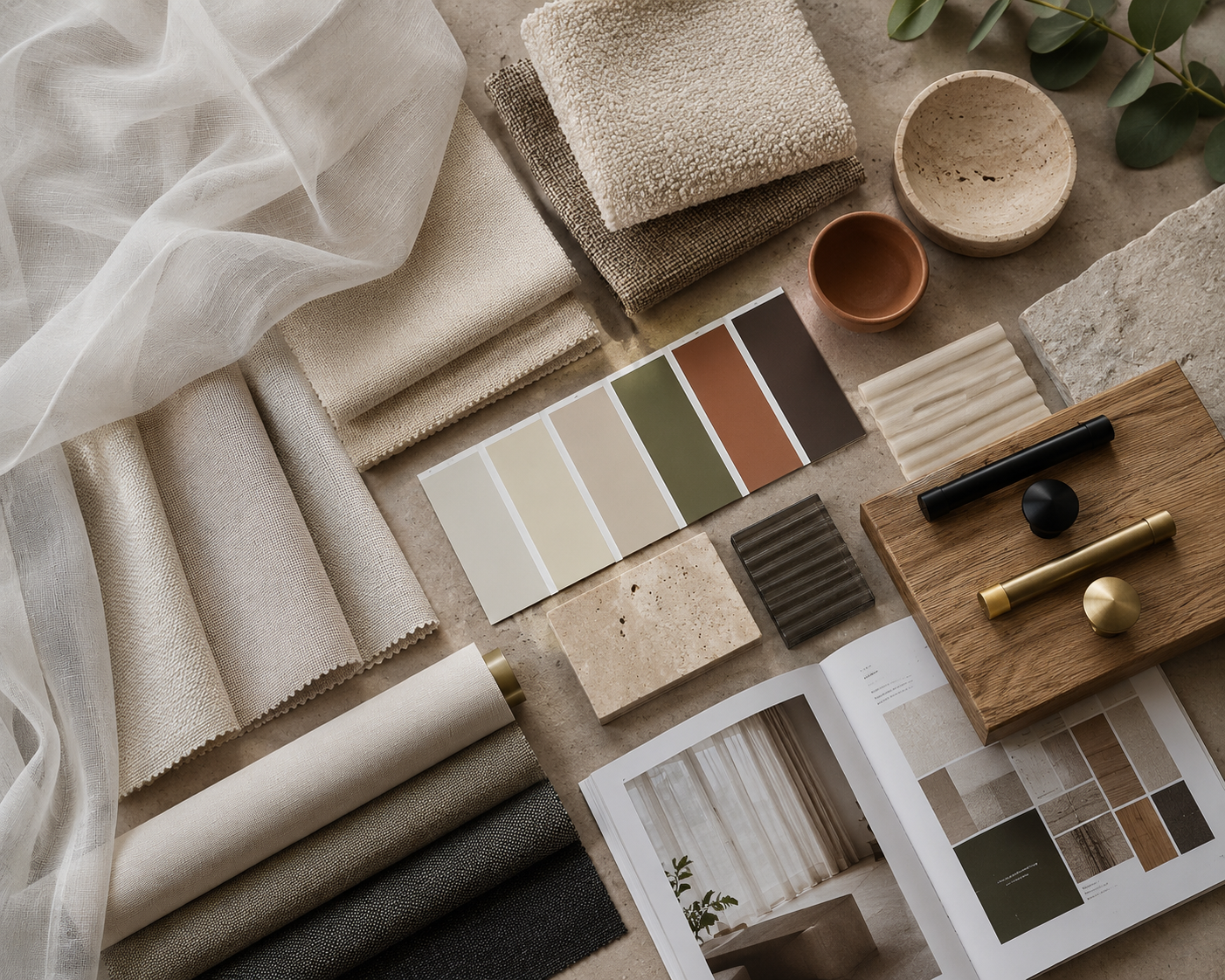
2026 window covering trends are embracing layered textures, earthy neutrals, warm timber tones and premium natural materials - reflecting the growing demand for sophisticated, commercial-grade interiors inspired by contemporary Australian design.
For projects that need true light control alongside this softer palette, our blockout vs blackout guide explains the difference: "Blockout fabric blocks light through material but allows edge gaps. Blackout systems combine fabric with sealed channels for 100% darkness."
What this means for your project
The thread running through 2026 is consistency. Sheer curtains, S-Wave headings, cellular blinds layered for performance, plantation shutters in warmer finishes, motorised systems as default, integrated outdoor automation, and a softer earth-toned palette across every category — these are not separate trends. They are facets of the same design direction: warmer, more tactile, quieter, more considered.
For premium residential clients, this is good news. The pieces being specified now have the depth and quality to last well beyond a single trend cycle. For interior designers and architects working on apartment developments, residential builds and commercial projects, the suppliers leading the category — Hunter Douglas, Luxaflex, the major Australian fabric houses — are aligned around the same direction, making coordinated specification more straightforward than it has been in years.Sun Solutions has been Western Australia's only licensed Hunter Douglas commercial dealer for more than two decades. We work with apartment developers, architects, builders, interior designers and discerning homeowners across Perth and WA on commercial-grade specifications and premium residential installations.
If you are planning a project for 2026, book a design consultation and we will walk through the options that suit your space, climate and brief.
Frequently asked questions about 2026 window covering trends
-
The defining 2026 trends are sheer curtains in linen and linen-blend fabrics, S-Wave curtain headings, cellular and honeycomb blinds for thermal performance, motorised systems as standard rather than as a luxury, integrated motorised awnings for indoor-outdoor living, and a warmer, earth-toned palette of cashmere cream, sandstone, oatmeal, sage and olive replacing the cool greys of the previous decade. Australian designers including Paul Hecker, Simone Haag and Neale Whitaker have described 2026 as a year of warmth, tactility and considered specification.
-
No. Pinch pleat curtains are now positioned as traditional rather than modern. The dominant contemporary curtain heading in Australia in 2026 is S-Wave (also called S-Fold), which produces a uniform architectural ripple suited to open-plan rooms and ceiling-mounted tracks. Pinch pleat continues to suit traditional and heritage interiors, but is not specified for contemporary residential or apartment developer projects.
-
S-Wave and S-Fold refer to the same modern curtain heading style. The terms are used interchangeably in Australia. The system uses a continuous wave-shaped track and glide arrangement to produce evenly spaced soft folds when the curtain is open or closed. S-Wave requires correct specification of track type, fabric weight and stack space to achieve a clean finish.
-
Motorised window coverings have moved from luxury upgrade to baseline specification in 2026. Luxaflex Australia describes motorisation as "evolving from a feature of convenience into an expected part of modern homes." Battery-powered motors with multi-year run times now make retrofitting straightforward, and integration with Google Home, Apple HomeKit and other home automation platforms is widely available. Motorisation is most commonly specified for hard-to-reach windows, large-format glazing, skylights and outdoor awnings.
-
Cool grey has been replaced by a warmer earth-toned palette. The 2026 direction includes cashmere cream, warm sandstone, oatmeal, soft mushroom, sage and olive. Stark whites have given way to off-whites and warm whites. The shift extends across all window covering categories — curtain fabrics, roller blinds, plantation shutter finishes, cellular blinds and outdoor awning fabrics.
-
Cellular and honeycomb blinds are the same product, with the names used interchangeably in Australia. The pleated double-cell construction creates air pockets that provide thermal insulation in both directions. Hunter Douglas Duette is the category benchmark and is widely specified in Australian premium residential and apartment developer projects for its energy performance and light filtering qualities.